
Education
Our Education and Life Skills programmes are the core curriculum that empowers our young people with the tools they need to thrive – not just as athletes, but as confident, resilient individuals ready for education, employment and life. Our nurturing approach means we move beyond theory, embedding these vital skills within the supportive, trusting relationships of our community.
Academic support:
We provide a stable, encouraging environment where academic growth is a key part of the journey. Dedicated weekly sessions offering targeted support in core subjects Maths, English and Science, helping to close attainment gaps and build academic confidence.
Our Education programme runs twice a week:
Tuesday (4 pm – 5 pm): Study Support
This session gives young people the chance to get help with the subjects they are studying from basic coursework up to GCSE level.
Saturday (9 am – 11 am): Tuition
We provide tuition for both the multi-skills group (ages 5-10) and our mainstream group (ages 10-21). During these sessions, we focus on the topic and questions students find challenging, helping them understand the subjects clearly and build the confidence to work independently
There is no added charge for our educational support.
Life skills
Test We equip our young people with the essential capabilities defined by our community as critical for their future. Our interactive workshops throughout the year focus on ten core life skills:
1. Listening
2. Presenting
3. Networking & social skills
4. Problem solving
5. Creativity
6. Staying positive
7. Aiming high
8. Discipline
9. Teamwork
10. Leadership
Here are some examples and cases that we have done with our life skills throughout the year.
Listening: Listening and repeating is where our students-athletes will have to listen to what the other team members have to say, and need to repeat it. This can be done through short sentences or long sentences.

Case Evidence: The reason for this is to get our students-athletes to pay attention and listen to what the other team members have to say. This will build confidence in our young people in listening when it comes to their training sessions, schools, and to prepare them for the world of work in which they will step into in the future.
Presentation: Presenting yourself will be about coming together in a team and presenting to a member of staff. The student-athletes will give the following: Their names, school, the reason why they train, their plans in Track Academy and what they gain from being in Track Academy.
Case Evidence: The reason for this is for our students-athletes to have confidence in talking and presenting themselves to members of staff and to other organisations. This builds resistance and becomes second nature when they are talking to other professional people.

Networking and Social Skills: Being able to confidently make connections with new people, whether one-to-one or in a group and with appropriate consideration of the setting and audience, are vital skills for young people to master.
Case Evidence: Our students-athletes have done a live networking event around the Sports Centre, and they will ask the staff members who have the sports centre uniform the following questions:

Discipline: Discipline helps you set goals, push yourself, and work hard. It helps you to take advice and listen to criticism without getting angry or losing heart. Discipline is what drives you on, to do your best, achieve your goals and be the best that you can be, even when you really don’t feel it. At Track Academy, all members are supported by mentors and coaches to learn discipline and to focus on small steps to build discipline into their lives. Especially for children from disadvantaged backgrounds, where lives can be very chaotic, this is a very important set of skills that is vital for future wellbeing and employability
Case Evidence: “Say no” to your favourite word or the bad habit that they have built within Track Academy. For the month of discipline, our students-athletes can not say the words “it’s hard” or ” I can’t do it. The goal is to build a strong mindset and resilience during their training. This will encourage them to be more disciplined in their other sphere and to have an “I can do it” mindset.
- How did you get into this field?
- What kind of skills do you learn in this field?
- What is the hardest part of their role?
- What is their name?
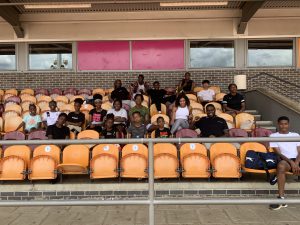
Aiming High: Through sports, young people learn to set goals, break down the steps to achieve those goals and push themselves to achieve each step. With the support of a strong coach, role models and mentors, sports inspire young people to aim high, not only in the sports field but in all aspects. of life.
Case Evidence: We asked our students-athletes to sit down in their groups alongside their coaches and write down their goals. The purpose of this event is for our students-athletes to have a goal for the year/season they are in now, and work towards that goal by keeping a standard that they set for themselves.

Staying Positive Although positive thinking can include recollection of previous sporting successes, the essence of positive thinking is to focus on the present goals at hand. While staying positive can help athletes to improve their own performance, taking part in sports can also make you feel better about yourself, more positive and more in control. Research shows that there is a significant psychological impact after 20 minutes of physical activity
At Track Academy, young people are supported to stay positive through mentoring, support from peers and role models and encouragement in all aspects of life to set goals, be their best and to show up and have fun.
Case Evidence: Student-Athletes will write down 2 things they enjoyed about athletics and one quote about what they like about Track Academy. The reason behind this is to understand their well-being and see if they are viewing sports a positive outcome.
Problem Solving: You take what you’re hearing, and you solve the problem. You solve the problem of reaching the deadline, getting to the competition, and being the best you can be. Ultimately, it’s up to you to listen to all the areas and then solve the problem at hand. Problem-solving is a key skill learnt through taking part in sports of any kind. One must be able to identify that there is a problem and know when to ask for help. develop strong personal strategies and evaluate potential solutions to identify the best ones, whether related to skills, techniques, mental barriers, or social constraints and external pressures.
At Track Academy, young athletes learn how to solve problems through working with their coach and mentors, leading groups and attending tuition sessions.
Case Evidence: Students-athletes have to plan an event with a budget of £500,000, based in New York, focused on influencers. We will give them a criterion and a list of prices of all the items they must have, and other accessories. The list will include security, food, DJ, travel decoration, influencer transport and more. They will have 30 minutes to brainstorm in teamd nd will have 5 minutes to explain all of their purchases.
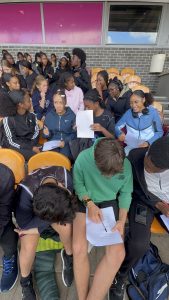
We do this to help our students better understand literacy finance and how to plan a budget. As they step into the world of work when they grow up, they need to understand how to control their money and spend what is necessary.
Creativity: Sport is creative. Every young person on the athletics track learns creativity from a young age, and the confidence to use their physical space and body to tell a young story of courage, passion, energy and confidence. Physical creativity is combined with mental creativity to envisage victory, push oneself to meet and beat goals and topkay and retain competition settings. Track Academy members learn to develop their creativity from a young age, as toddleers and through the multi-skills programmes, with a focus on fun self-expression.
Case Evidence: Participants will pick words from a magazine or newspaper, and then, within their groups, they have to select 6 to 10 words. Then, with the words that they have from a story, with the words they have chosen. The words can be arranged in any order.
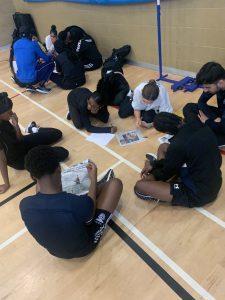
Teamwork: Sports without teamwork are nothing. Teamwork is so intrinsic to sport, even in individual sports like athletics. The teamwork aspect is a chemical thing. If you spent your formative years in sports, you know what you can achieve when you are part of a great team. You know how to be a team player, you learn what it feels like to let others down, but also to support others, work together, and give each other confidence. You learn to recognise the different skills and strengths of different team members and how each member differs, and individuality builds a stronger and more resilient team when harnessed effectively.
In sports, you learn how to work within a team, lead a team and how to recognise when a team isn’t working well together. You listen to your coach, take direction and inspire others.
Case Evidence: The students-athletes will work in a team to resolve the following arguments and complaints from a fake corporate company. The three arguments will be divided into the following: Easy, Medium and Hard. As a team, they need to resolve this professionally and come to a conclusion on how to resolve the three complaints.

Leadership: At Track Academy, young people learn to lead themselves and others. They have opportunities to volunteer as peer coaches, train to become qualified coaches, and start a career path to becoming a PE teacher, sports specialist, or manager. Our Mentors engage young athletes in career planning, goal-setting and leadership development, while athletics training sessions provide opportunities for group leadership, working with younger people and organising community events.
The athlete forum gives young people a voice in Track Academy’s strategic development and lets them discuss and lead changes to activities to meet changing needs.
Case Evidence: The Game is about leadership in a survival setting. The students-athletes will be split into teams (ideally 4-6 per team). Each team will choose a leader to survive for 1 week in Alaska, as well as up to 10 items (out of a possible 25). We assume they are dressed in warm clothing.
As the game goes on, the team can switch leaders (e.g. someone else emerges as a better leader or the leader no longer wants to be in that role). The team can also decide to break into 2 groups if they disagree.
Plot Twist: Halfway through the game, once teams have already chosen their items, Marion will say rescue actually comes in 2 months, so they can change what they’ve picked and add an extra 5 items.
Why:
- Leaders will be asked to share what they enjoyed and what was tough.
- Their groups will be asked what their leaders did well and what could be improved.
- It will be interesting to hear from any groups that switched leaders or split
- A winning group will be announced based on what they selected and their leader’s performance.
These aren’t just lessons; they are lived experiences. Young people practise teamwork during relay races, demonstrate discipline in training and build leadership by mentoring younger peers. Our integrated model ensures skills are learned, applied and reinforced every day, building resilience and self-belief. This entire journey is supported by the transformative, one-to-one relationships built through our dedicated Mentoring programme.

Knowledge and employability:
We hold regular sessions to get our older athletes ready for the world of work and further education. These could centre around CV writing, nutrition, finance and time management, with special guests often invited to share their own experiences. In addition, we hold visits to businesses across London so our young people can get a sense of what working life is like.
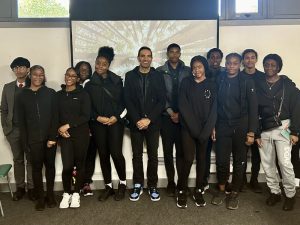
There is no extra charge for these sessions.
Lorem ipsum dolor sit amet, consectetur adipiscing elit. Ut elit tellus, luctus nec ullamcorper mattis, pulvinar dapibus leo.